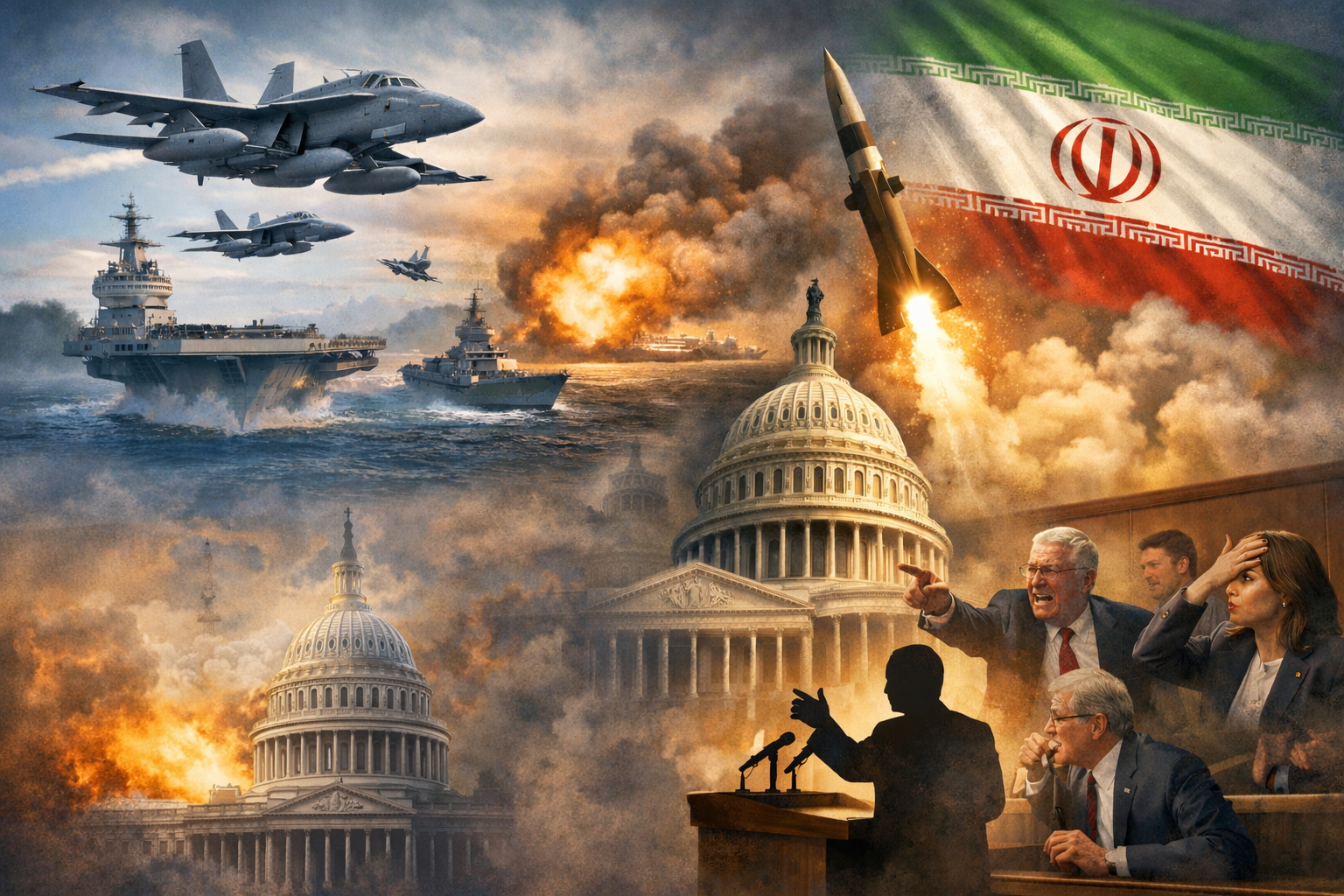
Public and Congressional Support: The Decisive Constraint That Can Turn U.S. Military Dominance Over Iran Into Strategic Defeat
The United States retains overwhelming advantages in the material and operational prerequisites of high-end conventional warfare. In any prospective conflict with Iran, Washington can assume advantages in air and naval superiority, intelligence and surveillance coverage, precision strike capacity, suppression of enemy air defenses, long-distance logistics, and advanced cyber and electronic warfare. Yet those advantages do not automatically translate into strategic success. The decisive variable is not whether the United States can destroy targets faster than an adversary can replace them, but whether the United States can sustain the political mandate to keep fighting after the initial shock of combat wears off, the costs become visible, and the enemy adapts.
This is the core vulnerability of a discretionary war with Iran. Public support and congressional support are not merely background noise or messaging challenges. They are strategic enablers. When they are absent or brittle, they shape rules of engagement, constrain time horizons, narrow acceptable costs, and fracture coalition cohesion. In that environment, even tactically brilliant operations can fail to achieve the most important objectives because political will collapses sooner than the enemy’s capacity to resist. Vo Nguyen Giap articulated this logic explicitly. A belligerent can leave enemy forces partly intact if it can destroy the enemy’s will to remain in the war. (PBS, n.d.) That insight was operationalized against the United States in Vietnam, echoed in Afghanistan, and remains relevant to any prospective United States-Iran war.
The Strategic Center of Gravity: Legitimacy and Endurance
Clausewitz argued that war is a continuation of politics by other means. In American practice, the political character of war is inseparable from constitutional structure and democratic consent. A war that begins without clear congressional authorization, or that proceeds amid broad public skepticism, can win battles while steadily losing its domestic foundation. The War Powers Resolution codifies Congress’s position that the President introduces U.S. forces into hostilities only pursuant to a declaration of war, specific statutory authorization, or a national emergency created by an attack on the United States or its forces. (50 U.S.C. § 1541, 1973) In a discretionary strike campaign that grows into sustained hostilities, the gap between executive action and legislative consent becomes a recurring legitimacy crisis rather than a one-time procedural dispute.
Recent reporting underscores that this institutional fault line is not theoretical. Reuters reported that the U.S. Senate rejected a bid to curb presidential Iran war powers, reflecting a live and lively, contested debate over authority and oversight in potential Iran hostilities. (Reuters, 2025) That debate matters operationally because contested legitimacy does not remain in Washington. It affects allied basing decisions, overflight permissions, intelligence sharing, escalation thresholds, and the credibility of U.S. signals to both adversaries and partners. A campaign that looks unilateral, politically improvised, or domestically unpopular becomes harder to sustain and easier for Iran and its proxy network to frame as illegitimate aggression.
Material Superiority Versus Political Fragility
From my perspective (military/intelligence), the United States can plausibly execute many of the classic prerequisites you listed. But those capabilities do not eliminate the central political question: what is the concrete objective, and how long will the American public accept the costs required to achieve it?
Public sentiment data indicates a serious constraint. A University of Maryland Critical Issues Poll found only 21 percent favor the United States initiating an attack on Iran, with 49 percent opposed and 30 percent unsure. (University of Maryland Critical Issues Poll, 2026) A YouGov report covering an Economist YouGov poll likewise found Americans more likely to oppose than to support using military force to attack Iran, with 49 percent opposing and 27 percent supporting, and with significant partisan and independent resistance. (YouGov, 2026) Meanwhile, an AP NORC poll found that while many Americans view Iran as an enemy and express concern about Iran’s nuclear program, they have low trust in presidential judgment on the use of military force, with only about three in ten expressing high trust and more than half expressing little or no trust. (Associated Press NORC, 2026)
The former being said, all of this has strategic implications. They suggest that domestic consent is not merely divided. It is structurally thin, with a large, uncertain middle and a relatively small affirmative mandate for initiating war. Low confidence in the decision maker’s judgment means that early setbacks or civilian casualties can rapidly convert uncertainty into opposition. Further, thin consent invites legislative confrontation, and legislative confrontation invites operational constraints. This is exactly the kind of environment in which an adversary designs a strategy of political attrition rather than symmetrical military competition.
Vietnam: Giap’s Theory of Victory Was Political
The claim that “North Vietnam did not win the Vietnam War” can be true in a narrow kinetic sense. The United States inflicted vast battlefield losses and dominated many tactical engagements. Yet North Vietnam and the Viet Cong were able to outlast the United States by targeting the political will that sustained American participation. Giap described the objective as breaking “the American will to remain in the war,” using operations intended to force de-escalation and reshape the political calculus in Washington. (PBS, n.d.) The point is not that one event alone decided the outcome. The point is that the adversary’s theory of victory treated American domestic endurance as the center of gravity. Once that center weakened, America’s material advantages could not convert into a stable political settlement on acceptable terms.
For an Iran scenario, the parallel is not an exact replay of Vietnam’s terrain or insurgency structure. The parallel is “strategic method”. Iran does not need to win a conventional air-sea contest. It needs to ensure that the United States does not achieve its most important objectives at a politically acceptable cost. If Iran can force Washington into a cycle of escalation and retaliation, or can trigger regional proxy pressure that steadily raises the price of engagement, then the war becomes a contest of domestic patience more than a contest of platforms.
Afghanistan and the Logic of “Time”
The Afghanistan experience reinforces the same strategic logic through a different mode of war. A saying widely attributed to Taliban fighters captures the asymmetry of time horizons: “You have the watches, we have the time.” (Maclean’s, 2017) The exact provenance of the phrase is less important than its strategic meaning. The U.S. Administration is about fall into the same bullshit trap. Democracies fight under time constraints produced by elections, news cycles, budget politics, and public casualty sensitivity. Insurgent and revolutionary actors often fight under generational horizons, with lower sensitivity to near term losses and a stronger tolerance for prolonged hardship.
Iran’s leadership and its proxy network have repeatedly demonstrated a long-horizon approach to regional strategy. In a conflict, Iran can employ calibrated escalation through proxies, maritime harassment, missile and drone pressure, and political warfare aimed at eroding coalition cohesion (a “coalition” of states that have already publicly objected to U.S. warplanning). The objective is not necessarily to defeat U.S. forces in the field. It is to make the conflict feel indefinite, morally ambiguous, and strategically distracting, which are precisely the conditions that drain public support in the United States.
“Shock and Awe” Does Not Solve the Political Problem
Advocates of rapid strike campaigns often argue that overwhelming early force can preempt political attrition by ending the conflict quickly. History offers caution. Initial public support (pretty clearly NOT the case today) can be high at the onset of a war, but it can erode sharply as the war’s duration and costs expand, particularly if the rationale becomes contested. The Iraq example is instructive: Gallup reported 72 percent support for the war against Iraq in late March 2003. (Gallup, 2003) Yet Gallup later documented substantial erosion in perceived worth and support over time as realities on the ground diverged from initial expectations. (Gallup, 2006) The Brookings analysis of early Iraq war opinion similarly underscores the rally effect and its limits. (Kull, Ramsay, and Lewis, 2003)
For Iran, the political risk is heightened because current polling suggests the United States would begin without anything like the 2003 level of public backing. (University of Maryland Critical Issues Poll, 2026) (YouGov, 2026) (Associated Press NORC, 2026) Without a broad initial mandate, the usual pattern reverses: instead of rallying, creating a cushion against early shocks, early shocks can collapse a narrow coalition of support. Moreover, Iran is structurally capable of generating early shocks through proxy responses and regional disruption, meaning that the political challenge may begin immediately, not after months or years.
Congress as a Strategic Actor, Not a Background Variable
In a system where Congress controls funding and has constitutional war powers, the legislative branch becomes a de facto strategic actor. When Congress is divided, when authorization is ambiguous, or when the public is skeptical, Congress can constrain the war through funding restrictions, reporting requirements, and political signaling that affects allied behavior. Reuters reporting on war powers debates around Iran illustrates that these conflicts are not hypothetical. (Reuters, 2025) Even the sycophants are likely to run out of patience for another endless foray, largely due to constituent pressure rather than disloyalty to their cult.
This really matters. Strategic clarity requires durable political consensus. If objectives are unclear or expand, congressional opposition becomes more likely and more intense. Further, Iran can exploit visible domestic division through information operations, propaganda, and calibrated escalation intended to polarize U.S. politics. In that sense, a weak domestic mandate is not merely a constraint on U.S. freedom of action. It becomes a targetable vulnerability. The North Vietnamese knew it. The Afghans knew it, and the more sober members of the Department of Defense know it.
A Missing Ingredient: Defined, Credible Political Objectives
Even if the United States can strike nuclear facilities, degrade air defenses, and disrupt command networks, the strategic question remains what “winning” means and what settlement conditions are realistically attainable. If the objective is limited, such as delaying nuclear capabilities, the question becomes whether limited objectives justify the costs and risks of regional escalation. If the objective expands to regime change, the problem becomes far harder because military destruction does not automatically produce political legitimacy, stable governance, or a non-hostile successor regime. Here, the user’s final criterion is decisive. Post-conflict planning, a wicked difficult peril that we have botched over and over again, will repeat itself. History shows that military victory without a stabilization strategy yields strategic failure, and the public tends to punish wars that feel open-ended, morally muddled, or poorly planned.
In the Iran case, this risk is amplified because a strike campaign can trigger proxy retaliation in multiple theaters, raise energy and shipping risks, and produce unpredictable political reverberations, all of which can be framed domestically as an optional war of choice rather than a necessary act of self-defense. When a war’s necessity is contested, public support becomes the decisive front.
Dominance in Combat Power Does Not Guarantee Strategic Success
The United States may indeed be dominant across many of the operational categories that matter for battlefield performance. Yet wars are not won solely by platform superiority. They are won by aligning military means with politically sustainable ends. Current public opinion suggests a narrow and fragile mandate for initiating an attack on Iran, combined with low confidence in executive judgment about the use of force. (University of Maryland Critical Issues Poll, 2026) (YouGov, 2026) (Associated Press NORC, 2026) In that environment, congressional contention over authorization and war powers becomes a predictable friction point, not an occasional procedural dispute. (50 U.S.C. § 1541, 1973) (Reuters, 2025) Iran and its proxy network do not need to defeat the United States conventionally to succeed strategically. They need to prolong, complicate, and regionalize the conflict until the United States loses the will and domestic legitimacy to continue, echoing Giap’s theory of victory in Vietnam and the time horizon logic captured by the Afghanistan aphorism. (PBS, n.d.) (Maclean’s, 2017)
A United States attack on Iran will NOT end well. We’ll have tactical dominance paired with a complete strategic disaster. Without sustained public and congressional support, the United States will fail to achieve its most important objectives (if the Administration can even articulate them) at an acceptable cost. The venture will not end with a clear victory, but with political exhaustion and a forced search for exit ramps. That is not my political critique. It is a strategic assessment rooted in how democratic states actually choose war and wage war. My call? Don’t f. do it. Exaggerations about “days from completing a nuclear weapon” coupled with no clear objective or endgame is a movie that we’ve seen before.
Bibliography
- Associated Press NORC Center for Public Affairs Research. 2026. “Most Americans see Iran as enemy but doubt Trump on military force: poll.” Associated Press.
- 50 U.S.C. § 1541. 1973. War Powers Resolution, “Purpose and policy.” Legal Information Institute, Cornell Law School.
- Gallup. 2003. “Seventy Two Percent of Americans Support War Against Iraq.” Gallup News Service, March 24, 2003.
- Gallup. 2006. “Three Years of War Have Eroded Public Support.” Gallup News Service, March 17, 2006.
- Kull, Steven, Clay Ramsay, and Evan Lewis. 2003. “Rally Round the Flag: Opinion in the United States before and after the Iraq War.” Brookings Institution.
- Maclean’s. 2017. “Fighting in Afghanistan: ‘You have the watches. We have the time’.” September 2, 2017.
- PBS. n.d. “Peoples Century: Guerrilla Wars: Vo Nguyen Giap Transcript.” Public Broadcasting Service.
- Reuters. 2025. “US Senate rejects bid to curb Trump’s Iran war powers.” June 27, 2025.
- University of Maryland Critical Issues Poll. 2026. “Do Americans Favor Attacking Iran Under the Current Circumstances? The Latest Critical Issues Poll Findings.”
- YouGov. 2026. “Few Americans support U.S. military action against Iran, but a majority think it’s likely.” Economist YouGov poll, February 20 to 23, 2026.