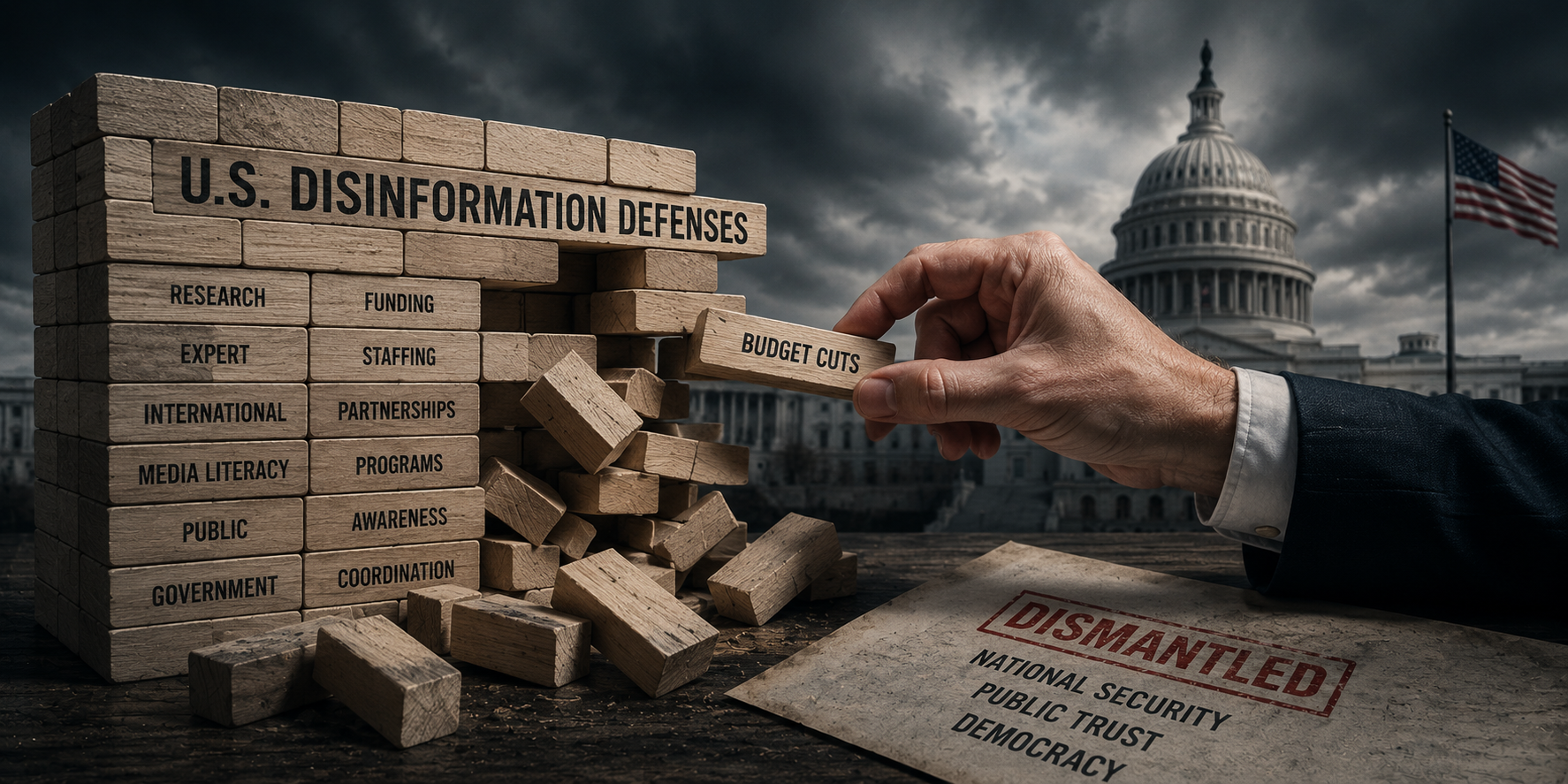
In the contemporary geopolitical landscape, the battle against disinformation has emerged as a critical front in maintaining national security and democratic integrity. It is hybrid warfare, plain and simple, . . . offensive operations in the “grey zone” the theorists like to call it. The United States has been systematically and purposefully disarming itself in this information warfare through a series of policy decisions and institutional changes that constitute nothing less than a strategic surrender. By examining the dismantling of counter-disinformation agencies, reduction of international alliances, constraints on broadcasting capabilities, prioritization of tech deregulation, and the purging of experienced intelligence personnel, my thoughts here demonstrate how these actions collectively represent a deliberate retreat rather than a mere series of isolated administrative changes. I am also going to share here my opinion on the implications of this unilateral disarmament for U.S. national security interests and the broader information ecosystem, concluding with a stark assessment of America’s vulnerability in an era of escalating information warfare.
The information environment has become a critical domain of modern warfare, where adversaries can achieve strategic objectives without firing a single shot. Russia’s 2026 budget allocation of $1.77 billion for propaganda efforts, supplemented by covert troll farms, front organizations, and cyber operations, demonstrates the seriousness with which state actors approach information warfare (Geraghty, 2026). Against this backdrop of escalating adversarial investment, the United States has paradoxically moved in the opposite direction, systematically dismantling its counter-disinformation infrastructure and capabilities in what can only be described as a deliberate act of strategic self-immolation.
My blog essay here examines how the United States has unilaterally disarmed itself in the information war through a series of deliberate policy choices that extend beyond mere administrative inefficiency to constitute a comprehensive strategic withdrawal. The evidence suggests this represents a fundamental recalibration of America’s approach to information warfare with profound and deeply troubling implications for national security. By examining the various dimensions of this disarmament, from institutional dismantling to personnel purges, we can better understand the emerging vulnerabilities in America’s information defenses and the strategic vacuum being created for adversaries to exploit.
The Systematic Dismantling of Counter-Disinformation Infrastructure
The most striking example of America’s unilateral disarmament in the information war is the systematic dismantling of its counter-disinformation infrastructure. The Trump administration has implemented policies that effectively prohibit federal agencies from combating misinformation or disinformation not tied to criminal activity, barring efforts that had previously been central to America’s information defense strategy (Nurick, 2026). This policy shift represents a fundamental reorientation of federal priorities away from proactive counter-disinformation work toward a reactive posture that only addresses disinformation when it rises to the level of criminal activity, a threshold that most sophisticated influence operations never cross.
The impact of this policy shift has been particularly devastating for agencies that had developed specialized expertise in tracking and countering foreign influence operations. The Global Engagement Center (GEC) at the State Department, which had been at the forefront of exposing Russian, Chinese, and Iranian disinformation campaigns, has seen its mandate severely constrained. Similarly, the Cybersecurity & Infrastructure Security Agency’s “Mis-, Dis-, and Malinformation Resource Library” has been effectively sidelined as part of a broader effort to scrub references to “misinformation” and “disinformation” from technical documents and official communications (Nurick, 2026). This linguistic cleansing reflects a deeper ideological opposition to the very concept of counter-disinformation as a legitimate government function.
Perhaps most alarmingly, the Trump administration has moved to politicize the research funding process that underpins America’s ability to understand and counter disinformation. A recent proposal would give political appointees at federal science agencies the role of approving all scientific research awards, replacing the traditional merit-based system determined by apolitical expert scientists (Lofgren, 2026). As Ranking Member Zoe Lofgren has warned, this move “would destroy what remains of merit-based review, dealing a crippling blow to science” and specifically targets research on topics deemed “politically inconvenient” (Lofgren, 2026). This politicization of research funding effectively ensures that studies of foreign disinformation campaigns and their effects will be starved of resources, leaving America blind to the very threats it should be countering.
The Purging of Expertise and Institutional Knowledge
The deliberate disarmament of America’s counter-disinformation capabilities extends beyond institutional structures to include the systematic purging of experienced personnel from key agencies. The Trump administration has targeted career intelligence analysts and counter-disinformation specialists for removal, replacing them with political loyalists lacking the specialized expertise necessary to understand and counter sophisticated influence operations. This personnel purging represents perhaps the most damaging aspect of America’s unilateral disarmament, as it destroys institutional knowledge that cannot be quickly rebuilt.
The impact of these personnel losses is particularly acute in the counterintelligence domain, where understanding adversary tactics and intentions requires years of specialized experience and the development of deep analytic tradecraft. The departure of these experts has left critical gaps in America’s ability to detect and counter foreign influence operations, creating vulnerabilities that adversaries have been quick to exploit. Even more troubling, the administration has attempted to require all current and future federal employees to sign loyalty oaths that effectively prioritize political alignment over professional expertise (PBS NewsHour, 2026). This approach ensures that the remaining counter-disinformation capabilities will be staffed by personnel selected for their political reliability rather than their analytic acumen.
The personnel purges have also disrupted the continuity of counter-disinformation efforts and severed critical professional networks. Many of the departed officials had developed deep expertise in specific adversary approaches and maintained professional relationships with their counterparts in other countries. Their departure has not only eliminated this expertise from government service but has also disrupted these critical networks and relationships, further isolating the U.S. from the broader counter-disinformation community. This isolation is particularly damaging given the transnational nature of modern influence operations, which require coordinated multinational responses to be effectively countered.
The Strategic Withdrawal from International Information Partnerships
The U.S. retreat from counter-disinformation extends beyond domestic institutions to include the weakening of international alliances and partnerships that had proven effective in combating foreign influence operations. The Trump administration’s “America First” approach has systematically undermined the collaborative frameworks that had been developed to share information about disinformation campaigns and coordinate responses across borders. This withdrawal from international partnerships represents a strategic miscalculation that leaves both the United States and its allies more vulnerable to foreign influence operations.
The impact of this withdrawal is already visible in the declining effectiveness of multinational initiatives like the EU vs Disinfo program and NATO’s strategic communications center, which had worked closely with U.S. agencies to expose Russian and Chinese influence operations. Without U.S. leadership and intelligence support, these partnerships have struggled to maintain their effectiveness against increasingly sophisticated adversaries. This is particularly damaging for smaller nations that lack the resources to develop their own counter-disinformation capabilities and have relied on U.S. support to counter foreign influence operations.
The strategic withdrawal from international partnerships is particularly concerning given the evolving nature of modern influence operations. As Russia, China, and other state actors have developed more sophisticated approaches to information warfare, they have increasingly targeted not just the United States but its allies and partners as well. By withdrawing from these partnerships, the United States has not only isolated itself but has also left its allies more vulnerable to influence operations that ultimately serve to undermine the broader Western alliance system. This strategic withdrawal represents a failure to recognize that information warfare is fundamentally a transnational threat that requires coordinated multinational responses.
The Constraining of Broadcasting and Public Diplomacy Capabilities
The constraints on Voice of America (VOA) and other international broadcasters represent a particularly damaging form of unilateral disarmament. These services had developed sophisticated approaches to reaching audiences in closed societies, often at great risk to their local partners and journalists. By providing independent news and information to audiences that otherwise lack access to unbiased reporting, these broadcasters served as a critical counterweight to state-sponsored propaganda and an important tool of public diplomacy.
The Trump administration has systematically undermined these broadcasting capabilities through budget cuts, leadership changes, and policy directives that have effectively neutered their ability to fulfill their missions. The administration has instructed managers to “reduce performance, . . . to the minimum presence and function required by law,” effectively gutting these organizations’ ability to conduct meaningful public diplomacy (Nurick, 2026). This approach stands in stark contrast to the investments being made by adversaries like Russia, which has expanded its RT network (a known Russian FIS propaganda channel forced to register as a foreign agent) from a traditional broadcaster to an entity with sophisticated cyber capabilities that conducts information operations and covert influence activities worldwide.
The constraining of U.S. broadcasting capabilities is particularly damaging in the context of modern authoritarianism, which increasingly relies on controlling information environments to maintain power. By limiting the ability of U.S. broadcasters to reach these audiences, the United States has effectively abandoned one of its most effective tools for supporting democratic aspirations and countering state propaganda. This retreat is particularly ironic given that these same broadcasters had been instrumental in countering Soviet propaganda during the Cold War—a historical precedent that suggests their current value should be recognized rather than diminished.
The Prioritization of Tech Deregulation Over Information Security
Another dimension of America’s unilateral disarmament in the information war is the prioritization of tech deregulation over information security. While private technology platforms have become the primary battleground for influence operations, the U.S. has moved toward reducing oversight rather than strengthening it. This approach reflects a fundamental misunderstanding of the role that technology platforms play in modern information warfare and the responsibility that both government and industry share for protecting the information ecosystem.
The Trump administration has consistently opposed regulation of technology platforms, even as evidence mounts that these platforms are being exploited by foreign actors to conduct influence operations. This deregulatory approach stands in stark contrast to the recognition by previous administrations that technology platforms play a critical role in both the dissemination of accurate information and the propagation of disinformation. By prioritizing deregulation over information security, the United States has effectively surrendered one of its most potent tools for countering foreign influence operations.
The impact of this deregulatory focus is particularly concerning given the evolving tactics of foreign influence operations. As state actors have developed more sophisticated approaches to information warfare, they have increasingly exploited the vulnerabilities of technology platforms to conduct influence operations at scale. Without adequate oversight and cooperation between government and technology companies, these platforms remain vulnerable to manipulation by foreign actors. The U.S. approach of prioritizing deregulation over information security effectively ensures that these vulnerabilities will remain unaddressed, creating significant opportunities for adversaries to exploit.
The Strategic Implications of Unilateral Disarmament
The cumulative effect of these various dimensions of unilateral disarmament is a significant reduction in America’s ability to compete in the information environment. This retreat has several deeply troubling strategic implications that extend beyond immediate tactical considerations to fundamental questions about America’s ability to protect its interests in an era of information warfare.
Unilateral disarmament creates asymmetries that adversaries can exploit with increasing effectiveness. While Russia, China, and other state actors continue to invest heavily in influence operations—with Russia alone allocating $1.77 billion to propaganda efforts in its 2026 budget—the United States has reduced its capabilities to counter these activities (Geraghty, 2026). This imbalance allows adversaries to shape narratives and influence public opinion with minimal resistance, creating strategic opportunities that they are already exploiting to advance their interests at America’s expense.
The U.S. withdrawal undermines the credibility of its commitments to allies and partners. The inability or unwillingness to maintain counter-disinformation capabilities raises questions about America’s reliability as a security partner, particularly for nations facing intense information warfare campaigns from adversaries. This credibility gap has already begun to reshape alliance dynamics, with some partners questioning whether they can count on U.S. support in the face of foreign influence operations. These doubts have broader implications for alliance cohesion and the ability of the United States to lead collective responses to shared security challenges.
Unilateral disarmament erodes America’s ability to protect its own democratic institutions from foreign influence. As foreign disinformation campaigns aim to “manipulate and weaken adversaries” through tactics designed to “discredit, divide, disarm, and demoralize them,” the United States becomes increasingly vulnerable to these influence operations (Geraghty, 2026). The January 6th Capitol attack and subsequent events have demonstrated how effectively foreign influence operations can exploit existing divisions within American society, a vulnerability that will only grow as counter-disinformation capabilities continue to be dismantled.
The Ideological Dimensions of the Disarmament Strategy
Perhaps most troubling about America’s unilateral disarmament in the information war is the ideological dimension that underlies these policy choices. The systematic dismantling of counter-disinformation capabilities appears to be driven not by pragmatic considerations of effectiveness or efficiency but by a fundamental ideological opposition to the very concept of government involvement in countering disinformation. This ideological opposition manifests in policies that prioritize political loyalty over expertise, deregulation over security, and isolation over cooperation.
The ideological dimensions of this disarmament strategy are particularly evident in the Trump administration’s approach to research funding and scientific expertise. By seeking to place political appointees in control of research funding decisions, the administration has demonstrated a preference for politically convenient narratives over evidence-based analysis (Lofgren, 2026). This approach extends to the very language used to discuss information warfare, with terms like “misinformation” and “disinformation” being systematically scrubbed from official documents and communications (Nurick, 2026). This linguistic cleansing reflects a deeper ideological opposition to acknowledging the existence and threat of foreign influence operations.
The ideological dimensions of the disarmament strategy are also evident in the administration’s approach to international partnerships and alliances. The systematic withdrawal from multinational counter-disinformation initiatives reflects not just a pragmatic assessment of costs and benefits but a deeper ideological opposition to collective approaches to security challenges. This “America First” approach assumes that the United States can effectively address information warfare threats on its own, despite abundant evidence to the contrary. This ideological isolationism leaves America more vulnerable to influence operations while simultaneously undermining the collective security architecture that had been developed to counter these threats.
The Path to Strategic Vulnerability
The evidence that I have presented in this piece demonstrates that the United States has been systematically and purposefully disarming itself in the war on disinformation. Through the dismantling of counter-disinformation agencies, cutting of international alliances, constraints on broadcasting capabilities, prioritization of tech deregulation, banning of funding for independent researchers, and purging of experienced intelligence personnel, the U.S. has created significant vulnerabilities in its information defenses.
This unilateral disarmament is particularly concerning given the escalating investments by adversaries in influence operations. As Russia’s 2026 budget allocation of $1.77 billion for propaganda efforts demonstrates, state actors are increasingly viewing the information environment as a critical domain of warfare (Geraghty, 2026). The U.S. retreat from this domain represents not just a strategic miscalculation but a deliberate surrender with profound implications for national security and the future of democratic governance.
Reversing this unilateral disarmament will require more than simply restoring previous programs and initiatives. It will require a fundamental reorientation of America’s approach to information warfare. This must include rebuilding counter-disinformation capabilities, restoring international partnerships, redeveloping expertise in countering foreign influence operations, and most importantly, rejecting the ideological opposition to government involvement in countering disinformation. Until such efforts are undertaken, the United States will remain at a significant disadvantage in the information environment, unable to effectively counter the sophisticated influence operations being conducted by its adversaries.
The stakes in this information war could not be higher. As foreign actors continue to exploit America’s self-inflicted vulnerabilities, the very foundations of democratic governance are at risk. The unilateral disarmament of America’s counter-disinformation capabilities represents not just a strategic retreat but a betrayal of the government’s fundamental responsibility to protect the nation from foreign threats, both conventional and informational, and both foreign and domestic. So pronounced is the betrayal that experienced elements in the U.S. Intelligence Community, addressing the malign information operations of Russian FIS as an example, have stated clearly, “We couldn’t do a worse job if Putin himself was sitting in the White House and giving orders.” Without a course correction, the United States will continue to cede the information environment to its adversaries, with consequences that will reverberate for generations to come.
Bibliography
- Geraghty, Jim. 2026. “In the disinformation war, the U.S. unilaterally disarmed.” The Washington Post, May 26.
- Lofgren, Zoe. 2026. “Ranking Member Lofgren Slams Trump Administration for Plan to Politicize Research Funding Process, Undermine Expert Review.” House Committee on Science, Space, and Technology Democrats, May 29.
- Nurick, Jacob K. 2026. “The Trump administration’s goals, outlined in Project 2025, were to weaken federal…” Facebook post, April 15.
- PBS NewsHour. 2026. “The Trump administration wants all current and future federal…” Facebook post, March 22.
- Myers, Steven Lee. 2026. “Trump Officials Try to Fight Foreign Disinformation They Once…” The New York Times, April 1.