Deliberate Disarmament: How the United States is Systematically Dismantling its Disinformation Defenses

disinformation, information warfare, grey zone, influence operations, Russian FIS, psyops, intelligence, counterintelligence, DIA, CIA, NSA;

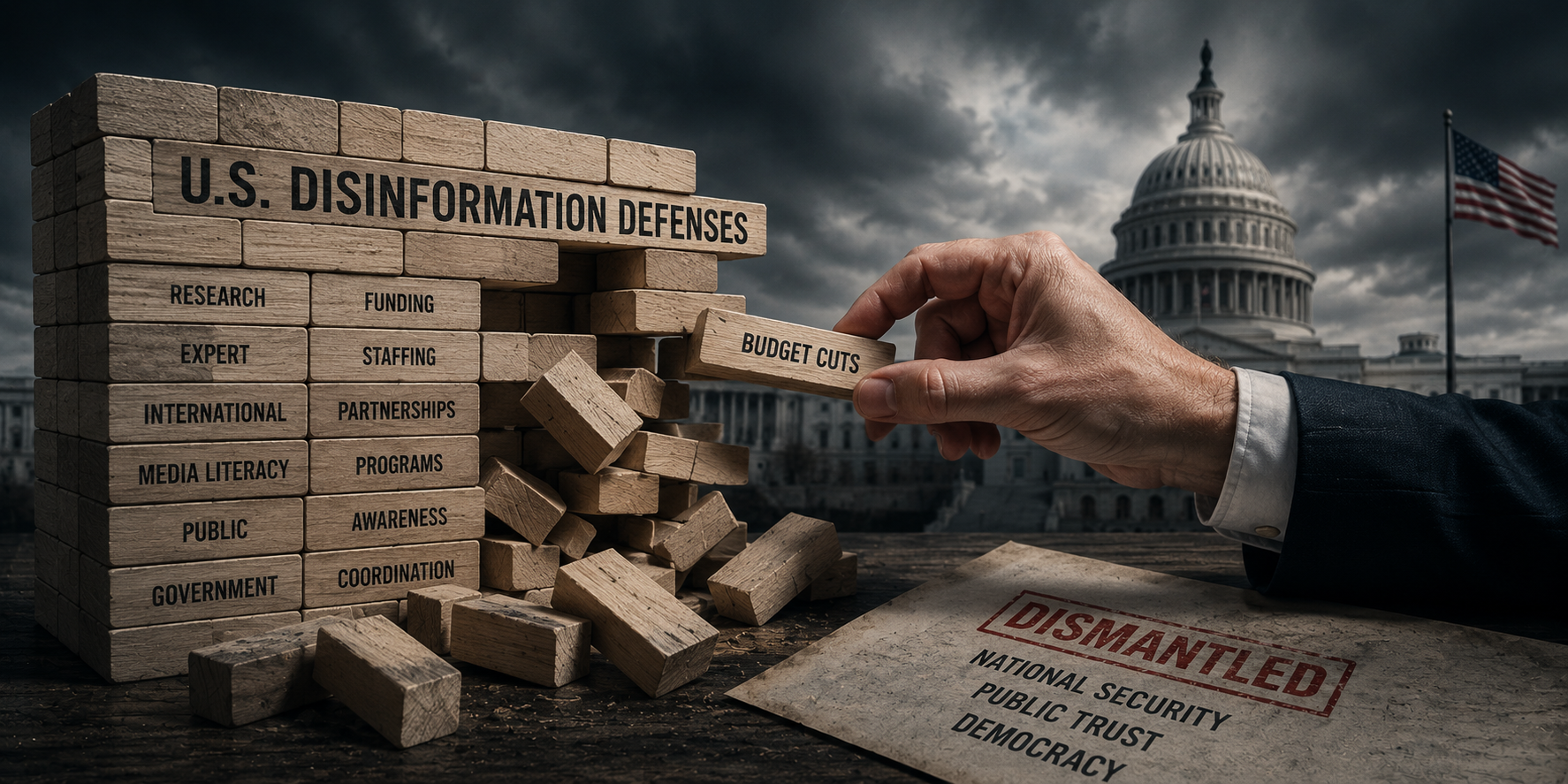
In the contemporary geopolitical landscape, the battle against disinformation has emerged as a critical front in maintaining national security and democratic integrity. It is hybrid warfare, plain and simple, . . . offensive operations in the “grey zone” the theorists like to call it. The United States has been systematically and purposefully disarming itself in this information warfare through a series of policy decisions and institutional changes that constitute nothing less than a strategic surrender. By examining the dismantling of counter-disinformation agencies, reduction of international alliances, constraints on broadcasting capabilities, prioritization of tech deregulation, and the purging of experienced intelligence personnel, my thoughts here demonstrate how these actions collectively represent a deliberate retreat rather than a mere series of isolated administrative changes. I am also going to share here my opinion on the implications of this unilateral disarmament for U.S. national security interests and the broader information ecosystem, concluding with a stark assessment of America’s vulnerability in an era of escalating information warfare.

The information environment has become a critical domain of modern warfare, where adversaries can achieve strategic objectives without firing a single shot. Russia’s 2026 budget allocation of $1.77 billion for propaganda efforts, supplemented by covert troll farms, front organizations, and cyber operations, demonstrates the seriousness with which state actors approach information warfare (Geraghty, 2026). Against this backdrop of escalating adversarial investment, the United States has paradoxically moved in the opposite direction, systematically dismantling its counter-disinformation infrastructure and capabilities in what can only be described as a deliberate act of strategic self-immolation.

My blog essay here examines how the United States has unilaterally disarmed itself in the information war through a series of deliberate policy choices that extend beyond mere administrative inefficiency to constitute a comprehensive strategic withdrawal. The evidence suggests this represents a fundamental recalibration of America’s approach to information warfare with profound and deeply troubling implications for national security. By examining the various dimensions of this disarmament, from institutional dismantling to personnel purges, we can better understand the emerging vulnerabilities in America’s information defenses and the strategic vacuum being created for adversaries to exploit.

The Systematic Dismantling of Counter-Disinformation Infrastructure

The most striking example of America’s unilateral disarmament in the information war is the systematic dismantling of its counter-disinformation infrastructure. The Trump administration has implemented policies that effectively prohibit federal agencies from combating misinformation or disinformation not tied to criminal activity, barring efforts that had previously been central to America’s information defense strategy (Nurick, 2026). This policy shift represents a fundamental reorientation of federal priorities away from proactive counter-disinformation work toward a reactive posture that only addresses disinformation when it rises to the level of criminal activity, a threshold that most sophisticated influence operations never cross.

The impact of this policy shift has been particularly devastating for agencies that had developed specialized expertise in tracking and countering foreign influence operations. The Global Engagement Center (GEC) at the State Department, which had been at the forefront of exposing Russian, Chinese, and Iranian disinformation campaigns, has seen its mandate severely constrained. Similarly, the Cybersecurity & Infrastructure Security Agency’s “Mis-, Dis-, and Malinformation Resource Library” has been effectively sidelined as part of a broader effort to scrub references to “misinformation” and “disinformation” from technical documents and official communications (Nurick, 2026). This linguistic cleansing reflects a deeper ideological opposition to the very concept of counter-disinformation as a legitimate government function.

Perhaps most alarmingly, the Trump administration has moved to politicize the research funding process that underpins America’s ability to understand and counter disinformation. A recent proposal would give political appointees at federal science agencies the role of approving all scientific research awards, replacing the traditional merit-based system determined by apolitical expert scientists (Lofgren, 2026). As Ranking Member Zoe Lofgren has warned, this move “would destroy what remains of merit-based review, dealing a crippling blow to science” and specifically targets research on topics deemed “politically inconvenient” (Lofgren, 2026). This politicization of research funding effectively ensures that studies of foreign disinformation campaigns and their effects will be starved of resources, leaving America blind to the very threats it should be countering.

The Purging of Expertise and Institutional Knowledge

The deliberate disarmament of America’s counter-disinformation capabilities extends beyond institutional structures to include the systematic purging of experienced personnel from key agencies. The Trump administration has targeted career intelligence analysts and counter-disinformation specialists for removal, replacing them with political loyalists lacking the specialized expertise necessary to understand and counter sophisticated influence operations. This personnel purging represents perhaps the most damaging aspect of America’s unilateral disarmament, as it destroys institutional knowledge that cannot be quickly rebuilt.

The impact of these personnel losses is particularly acute in the counterintelligence domain, where understanding adversary tactics and intentions requires years of specialized experience and the development of deep analytic tradecraft. The departure of these experts has left critical gaps in America’s ability to detect and counter foreign influence operations, creating vulnerabilities that adversaries have been quick to exploit. Even more troubling, the administration has attempted to require all current and future federal employees to sign loyalty oaths that effectively prioritize political alignment over professional expertise (PBS NewsHour, 2026). This approach ensures that the remaining counter-disinformation capabilities will be staffed by personnel selected for their political reliability rather than their analytic acumen.

The personnel purges have also disrupted the continuity of counter-disinformation efforts and severed critical professional networks. Many of the departed officials had developed deep expertise in specific adversary approaches and maintained professional relationships with their counterparts in other countries. Their departure has not only eliminated this expertise from government service but has also disrupted these critical networks and relationships, further isolating the U.S. from the broader counter-disinformation community. This isolation is particularly damaging given the transnational nature of modern influence operations, which require coordinated multinational responses to be effectively countered.

The Strategic Withdrawal from International Information Partnerships

The U.S. retreat from counter-disinformation extends beyond domestic institutions to include the weakening of international alliances and partnerships that had proven effective in combating foreign influence operations. The Trump administration’s “America First” approach has systematically undermined the collaborative frameworks that had been developed to share information about disinformation campaigns and coordinate responses across borders. This withdrawal from international partnerships represents a strategic miscalculation that leaves both the United States and its allies more vulnerable to foreign influence operations.

The impact of this withdrawal is already visible in the declining effectiveness of multinational initiatives like the EU vs Disinfo program and NATO’s strategic communications center, which had worked closely with U.S. agencies to expose Russian and Chinese influence operations. Without U.S. leadership and intelligence support, these partnerships have struggled to maintain their effectiveness against increasingly sophisticated adversaries. This is particularly damaging for smaller nations that lack the resources to develop their own counter-disinformation capabilities and have relied on U.S. support to counter foreign influence operations.

The strategic withdrawal from international partnerships is particularly concerning given the evolving nature of modern influence operations. As Russia, China, and other state actors have developed more sophisticated approaches to information warfare, they have increasingly targeted not just the United States but its allies and partners as well. By withdrawing from these partnerships, the United States has not only isolated itself but has also left its allies more vulnerable to influence operations that ultimately serve to undermine the broader Western alliance system. This strategic withdrawal represents a failure to recognize that information warfare is fundamentally a transnational threat that requires coordinated multinational responses.

The Constraining of Broadcasting and Public Diplomacy Capabilities

The constraints on Voice of America (VOA) and other international broadcasters represent a particularly damaging form of unilateral disarmament. These services had developed sophisticated approaches to reaching audiences in closed societies, often at great risk to their local partners and journalists. By providing independent news and information to audiences that otherwise lack access to unbiased reporting, these broadcasters served as a critical counterweight to state-sponsored propaganda and an important tool of public diplomacy.

The Trump administration has systematically undermined these broadcasting capabilities through budget cuts, leadership changes, and policy directives that have effectively neutered their ability to fulfill their missions. The administration has instructed managers to “reduce performance, . . . to the minimum presence and function required by law,” effectively gutting these organizations’ ability to conduct meaningful public diplomacy (Nurick, 2026). This approach stands in stark contrast to the investments being made by adversaries like Russia, which has expanded its RT network (a known Russian FIS propaganda channel forced to register as a foreign agent) from a traditional broadcaster to an entity with sophisticated cyber capabilities that conducts information operations and covert influence activities worldwide.

The constraining of U.S. broadcasting capabilities is particularly damaging in the context of modern authoritarianism, which increasingly relies on controlling information environments to maintain power. By limiting the ability of U.S. broadcasters to reach these audiences, the United States has effectively abandoned one of its most effective tools for supporting democratic aspirations and countering state propaganda. This retreat is particularly ironic given that these same broadcasters had been instrumental in countering Soviet propaganda during the Cold War—a historical precedent that suggests their current value should be recognized rather than diminished.

The Prioritization of Tech Deregulation Over Information Security

Another dimension of America’s unilateral disarmament in the information war is the prioritization of tech deregulation over information security. While private technology platforms have become the primary battleground for influence operations, the U.S. has moved toward reducing oversight rather than strengthening it. This approach reflects a fundamental misunderstanding of the role that technology platforms play in modern information warfare and the responsibility that both government and industry share for protecting the information ecosystem.

The Trump administration has consistently opposed regulation of technology platforms, even as evidence mounts that these platforms are being exploited by foreign actors to conduct influence operations. This deregulatory approach stands in stark contrast to the recognition by previous administrations that technology platforms play a critical role in both the dissemination of accurate information and the propagation of disinformation. By prioritizing deregulation over information security, the United States has effectively surrendered one of its most potent tools for countering foreign influence operations.

The impact of this deregulatory focus is particularly concerning given the evolving tactics of foreign influence operations. As state actors have developed more sophisticated approaches to information warfare, they have increasingly exploited the vulnerabilities of technology platforms to conduct influence operations at scale. Without adequate oversight and cooperation between government and technology companies, these platforms remain vulnerable to manipulation by foreign actors. The U.S. approach of prioritizing deregulation over information security effectively ensures that these vulnerabilities will remain unaddressed, creating significant opportunities for adversaries to exploit.

The Strategic Implications of Unilateral Disarmament

The cumulative effect of these various dimensions of unilateral disarmament is a significant reduction in America’s ability to compete in the information environment. This retreat has several deeply troubling strategic implications that extend beyond immediate tactical considerations to fundamental questions about America’s ability to protect its interests in an era of information warfare.

Unilateral disarmament creates asymmetries that adversaries can exploit with increasing effectiveness. While Russia, China, and other state actors continue to invest heavily in influence operations—with Russia alone allocating $1.77 billion to propaganda efforts in its 2026 budget—the United States has reduced its capabilities to counter these activities (Geraghty, 2026). This imbalance allows adversaries to shape narratives and influence public opinion with minimal resistance, creating strategic opportunities that they are already exploiting to advance their interests at America’s expense.

The U.S. withdrawal undermines the credibility of its commitments to allies and partners. The inability or unwillingness to maintain counter-disinformation capabilities raises questions about America’s reliability as a security partner, particularly for nations facing intense information warfare campaigns from adversaries. This credibility gap has already begun to reshape alliance dynamics, with some partners questioning whether they can count on U.S. support in the face of foreign influence operations. These doubts have broader implications for alliance cohesion and the ability of the United States to lead collective responses to shared security challenges.

Unilateral disarmament erodes America’s ability to protect its own democratic institutions from foreign influence. As foreign disinformation campaigns aim to “manipulate and weaken adversaries” through tactics designed to “discredit, divide, disarm, and demoralize them,” the United States becomes increasingly vulnerable to these influence operations (Geraghty, 2026). The January 6th Capitol attack and subsequent events have demonstrated how effectively foreign influence operations can exploit existing divisions within American society, a vulnerability that will only grow as counter-disinformation capabilities continue to be dismantled.

The Ideological Dimensions of the Disarmament Strategy

Perhaps most troubling about America’s unilateral disarmament in the information war is the ideological dimension that underlies these policy choices. The systematic dismantling of counter-disinformation capabilities appears to be driven not by pragmatic considerations of effectiveness or efficiency but by a fundamental ideological opposition to the very concept of government involvement in countering disinformation. This ideological opposition manifests in policies that prioritize political loyalty over expertise, deregulation over security, and isolation over cooperation.

The ideological dimensions of this disarmament strategy are particularly evident in the Trump administration’s approach to research funding and scientific expertise. By seeking to place political appointees in control of research funding decisions, the administration has demonstrated a preference for politically convenient narratives over evidence-based analysis (Lofgren, 2026). This approach extends to the very language used to discuss information warfare, with terms like “misinformation” and “disinformation” being systematically scrubbed from official documents and communications (Nurick, 2026). This linguistic cleansing reflects a deeper ideological opposition to acknowledging the existence and threat of foreign influence operations.

The ideological dimensions of the disarmament strategy are also evident in the administration’s approach to international partnerships and alliances. The systematic withdrawal from multinational counter-disinformation initiatives reflects not just a pragmatic assessment of costs and benefits but a deeper ideological opposition to collective approaches to security challenges. This “America First” approach assumes that the United States can effectively address information warfare threats on its own, despite abundant evidence to the contrary. This ideological isolationism leaves America more vulnerable to influence operations while simultaneously undermining the collective security architecture that had been developed to counter these threats.

The Path to Strategic Vulnerability

The evidence that I have presented in this piece demonstrates that the United States has been systematically and purposefully disarming itself in the war on disinformation. Through the dismantling of counter-disinformation agencies, cutting of international alliances, constraints on broadcasting capabilities, prioritization of tech deregulation, banning of funding for independent researchers, and purging of experienced intelligence personnel, the U.S. has created significant vulnerabilities in its information defenses.

This unilateral disarmament is particularly concerning given the escalating investments by adversaries in influence operations. As Russia’s 2026 budget allocation of $1.77 billion for propaganda efforts demonstrates, state actors are increasingly viewing the information environment as a critical domain of warfare (Geraghty, 2026). The U.S. retreat from this domain represents not just a strategic miscalculation but a deliberate surrender with profound implications for national security and the future of democratic governance.

Reversing this unilateral disarmament will require more than simply restoring previous programs and initiatives. It will require a fundamental reorientation of America’s approach to information warfare. This must include rebuilding counter-disinformation capabilities, restoring international partnerships, redeveloping expertise in countering foreign influence operations, and most importantly, rejecting the ideological opposition to government involvement in countering disinformation. Until such efforts are undertaken, the United States will remain at a significant disadvantage in the information environment, unable to effectively counter the sophisticated influence operations being conducted by its adversaries.

The stakes in this information war could not be higher. As foreign actors continue to exploit America’s self-inflicted vulnerabilities, the very foundations of democratic governance are at risk. The unilateral disarmament of America’s counter-disinformation capabilities represents not just a strategic retreat but a betrayal of the government’s fundamental responsibility to protect the nation from foreign threats, both conventional and informational, and both foreign and domestic. So pronounced is the betrayal that experienced elements in the U.S. Intelligence Community, addressing the malign information operations of Russian FIS as an example, have stated clearly, “We couldn’t do a worse job if Putin himself was sitting in the White House and giving orders.” Without a course correction, the United States will continue to cede the information environment to its adversaries, with consequences that will reverberate for generations to come.

C. Constantin Poindexter, MA in Intelligence, Graduate Certificate in Counterintelligence, JD, CISA/NCISS OSINT certification, DoD/DoS BFFOC Certification

Bibliography

  • Geraghty, Jim. 2026. “In the disinformation war, the U.S. unilaterally disarmed.” The Washington Post, May 26.
  • Lofgren, Zoe. 2026. “Ranking Member Lofgren Slams Trump Administration for Plan to Politicize Research Funding Process, Undermine Expert Review.” House Committee on Science, Space, and Technology Democrats, May 29.
  • Nurick, Jacob K. 2026. “The Trump administration’s goals, outlined in Project 2025, were to weaken federal…” Facebook post, April 15.
  • PBS NewsHour. 2026. “The Trump administration wants all current and future federal…” Facebook post, March 22.
  • Myers, Steven Lee. 2026. “Trump Officials Try to Fight Foreign Disinformation They Once…” The New York Times, April 1.


Share this post:

The Takaichi “Prompt Exploit” as Novel Tradecraft: A Counterintelligence Operator’s View of AI Enabled Influence Operations

disinformation, information operations, espionage, counterespionage, intelligence, counterintelligence, psyops, C. Constantin Poindexter, CIA, DIA, NSA

AI Enabled Smear Operations and Counterintelligence Detection: Lessons from the Attempted ChatGPT Exploit Targeting Sanae Takaichi

The attempted exploitation of ChatGPT to support a covert smear campaign against Japanese Prime Minister Sanae Takaichi is not a novelty story about AI gone wrong. It is a clear operational vignette of how modern state-linked actors or FIS attempt to compress the intelligence cycle and accelerate influence effects with generative tools. OpenAI’s February 25, 2026 threat reporting describes a now banned ChatGPT account linked to an individual associated with Chinese law enforcement who attempted in mid October 2025 to leverage the model to plan and execute a covert influence operation aimed at discrediting Takaichi, followed by later requests to edit “cyber special operations” status reports after the model refused the original operational ask (OpenAI, 2026). Public reporting based on that disclosure adds that the actor’s plan included coordinated negative commentary, impersonation techniques, and wedge framing designed to mobilize resentment around U.S. tariffs and immigration narratives (Jiji Press, 2026; Reuters, 2026; Axios, 2026). From a counterintelligence perspective, this is a case study in how an adversary treats a commercial large language model as a low-friction staff officer: ideation, drafting, message discipline, and iterative refinement, all without needing to recruit a human asset or expose internal tradecraft through overt tasking channels.

What makes the episode analytically valuable is the specificity of the improper tasking. Reporting indicates that the actor asked ChatGPT to draft a multi part plan to discredit Takaichi, to generate and help post and spread negative comments attacking her stances including immigration, to polish narratives and recurring status reports describing ongoing cyber special operations, and to inflame wedge grievances by amplifying anger over U.S. tariffs on Japan (Jiji Press, 2026; Axios, 2026; OpenAI, 2026). These requests form a recognizable information operations workflow: design the campaign, manufacture content, distribute content, or at least create distribution-ready material, and assess and iterate based on reporting. In classical counterintelligence terms, the operator sought to maximize plausible deniability, minimize cost, and raise tempo, substituting generative capacity for time-consuming human copywriting while reducing the number of personnel who must be read into the narrative engineering function (CISA, 2022; ODNI FMIC, 2024).

The most important counterintelligence observation is that the exploit is not primarily technical. It is procedural and behavioral. Operators do not need to jailbreak a model to gain advantage. They can ask for adjacent assistance such as language polishing, translation, formatting, summarization of internal memos, and audience-tailored variations. OpenAI’s reporting explicitly notes the actor returned after an initial refusal and asked for edits to operational status reports, which is precisely how professional services are laundered in many influence pipelines: when direct enablement is blocked, pivot to editorial support and documentation hygiene (OpenAI, 2026). This aligns with U.S. government’s framing of foreign malign influence as subversive, undeclared, coercive, or criminal activity that uses multiple pathways and intermediaries, often blending overt platforms with covert personas and synthetic content (ODNI FMIC, 2024; DOJ, n.d.). The model is not the operation. It becomes a friction reducer within the operation.

Seen through the lens of the intelligence cycle, the actor’s approach collapses collection, analysis, production, and dissemination into a tight loop. The multi-part plan request is campaign design, meaning objective, target audience, narrative lines, channels, and timing. The post-and-spread request is dissemination planning and, at minimum, the production of ready-to-publish material. The status report editing request is assessment: codifying observed effects, identifying what resonated, and deciding next moves (OpenAI, 2026; Axios, 2026). When an influence apparatus scales, this loop becomes industrialized: many accounts, multi-platform content seeding, and iterative narrative tuning. Reporting around the OpenAI threat case underscores that these efforts can be large-scale, resource-intensive, and sustained, consistent with a bureaucracy rather than hobbyist trolling (Reuters, 2026; CyberScoop, 2026). As Ben Nimmo has emphasized, the intent is to apply pressure everywhere, all at once, which is characteristic of FIS or state-linked coercive information operations rather than organic political discourse (Axios, 2026).

The operational targeting of Takaichi is also instructive for counterintelligence because it sits at the intersection of influence operations and transnational repression. While this case focuses on a smear campaign against a Japanese political figure, OpenAI’s broader description of the actor’s uploaded materials suggests a wider ecosystem aimed at suppressing dissent and silencing critics, including tactics such as forged documentation and intimidation narratives (OpenAI, 2026; CyberScoop, 2026). The FBI defines transnational repression to include online disinformation campaigns, harassment, intimidation, and abuse of legal processes, exactly the kinds of tools that can be amplified or routinized by AI-assisted content generation (FBI, n.d.). In counterintelligence risk terms, that convergence matters. When an adversary blends influence effects, shaping attitudes, with coercive effects, punishing or deterring speech, the target set expands from voters to voices, and the operational threshold for harm drops.

The wedge grievance element, stoking resentment over U.S. tariffs, illustrates classic influence tradecraft. Hijack a real grievance, inflate it, and attach it to the target as a blame object. This is not persuasion via factual argument. It is agitation via emotional mobilization. CISA guidance on foreign influence operations describes how adversaries exploit mis, dis, and malinformation narratives to bias policy and undermine social cohesion, often by inflaming divisive issues (CISA, 2022). The tariff frame is particularly useful because it can be pitched simultaneously as anti-U.S., blaming Washington, and anti-target, blaming Takaichi’s posture for provoking friction, with variants tailored to different audiences. In counterintelligence vocabulary, this is narrative multi-casting: the same kernel is repackaged into mutually reinforcing storylines for disparate communities.

The cross platform distribution pattern referenced in public reporting, activity on X and other sites, with relatively low engagement but persistent output, resembles the known Chinese influence pattern commonly labeled Spamouflage or Dragonbridge: high volume, mixed quality, low authentic engagement, but sustained presence and periodic tactical evolution (Reuters, 2026; NATO StratCom COE, 2023; Graphika, 2025). Low engagement does not mean low intent or low risk. It can indicate poor tradecraft, early-stage testing, or a campaign optimized for secondary effects such as search pollution, narrative seeding for later pickup, or creating “evidence” of public sentiment that can be cited elsewhere. Counterintelligence professionals should treat low engagement content as potential scaffolding. The objective may be to build a lattice of posts, screenshots, and proof artifacts that can later be laundered into higher credibility channels.

From the defender’s side, the case clarifies what model refusal can and cannot do. OpenAI reports that ChatGPT refused overtly malicious prompts, yet the actor appears to have proceeded using other tools and later used ChatGPT for editing (OpenAI, 2026). This reveals a strategic limitation. Safety filters reduce direct enablement. They do not eliminate the underlying operational capability of a state apparatus that can shift to domestic models, human copywriters, or alternative platforms. Effective mitigation requires a layered approach: model-side safeguards, platform-side enforcement, and inter-organizational intelligence sharing that treats AI as one component in a broader influence toolkit (OpenAI, 2026; CISA, 2024). The IC’s Foreign Malign Influence Center has emphasized that foreign malign influence is multi-actor and multi-pathway by design, which implies countermeasures must also be multi-pathway. Detection in one node rarely collapses the whole network (ODNI FMIC, 2024).

For counterintelligence operators, three takeaways are operationally salient. First, generative AI is best understood as an accelerant of existing influence doctrine rather than a replacement. It speeds up drafting, localization, and A B testing of narratives while enabling bureaucratic reporting to be produced faster and with greater stylistic consistency (OpenAI, 2026; CISA, 2022). Second, the human factor remains the decisive vulnerability. The actor’s interaction with ChatGPT created an evidentiary trail that allowed defenders to correlate intent, post-and-spread negative commentary with observed online activity. This is a reminder that operational security failures frequently occur in routine administrative behavior (OpenAI, 2026; CyberScoop, 2026). Third, influence and repression are increasingly convergent lines of effort. When disinformation is used not only to persuade but to intimidate, deplatform, or socially punish, the problem set expands to include civil liberties impacts, diaspora targeting, and sovereignty challenges (FBI, n.d.; DOJ, 2023).

In countermeasures terms, the Takaichi case underscores the value of structured analytic techniques in attribution and mitigation. Analysts should separate narrative content, behavioral signals such as posting cadence and account creation patterns, infrastructure signals such as hosting and coordinated link sharing, and procedural artifacts such as templated emails, repeated phrasing, and report formats. OpenAI’s account-level disruption, combined with open-source correlation to online hashtags and posts referenced in operational materials, is a template for fusion analysis that pairs platform telemetry with OSINT validation (OpenAI, 2026). NATO-aligned research similarly emphasizes that state-sponsored or FIS information operations exploit differences across platforms and jurisdictions. Defenders should expect rapid lateral movement when friction increases on any single platform (NATO StratCom COE, 2023).

The attempted exploit is best characterized as an “AI-enabled influence operation reconnaissance and production cycle, with the model treated as a drafting cell embedded in a broader state-linked apparatus”. The key question is not whether a model can be tasked with dissemination directly. It is whether it can generate dissemination-ready content, standardize narrative discipline, and reduce the time and training required to run a coordinated smear campaign. In this case, it could at least partially, until refusal controls forced the actor to route around and repurpose the model for editing and reporting (OpenAI, 2026; Jiji Press, 2026). For counterintelligence professionals, that reality demands a posture shift.. We must defend not only against disinformation artifacts but against the process improvements that AI grants adversaries. Faster cycles, lower labor costs, and more plausible linguistic camouflage are the new norm. The Takaichi operation appears to have underperformed in engagement, yet it is a forward indicator of how state-backed influence operational tradecraft is adapting to generative systems. They are persistent, multi-platform and procedurally agile (Reuters, 2026; Graphika, 2025).

C. Constantin Poindexter, MA in Intelligence, Graduate Certificate in Counterintelligence, JD, CISA/NCISS OSINT certification, DoD/DoS BFFOC Certification

Bibliography

  • Axios. (2026, February 25). Reporting on OpenAI’s disclosure of a China linked attempt to use ChatGPT to plan and refine a smear campaign targeting Japan’s Prime Minister Sanae Takaichi.
  • Cybersecurity and Infrastructure Security Agency. (2022). Preparing for and mitigating foreign influence operations (CISA Insight).
  • Cybersecurity and Infrastructure Security Agency. (2024, April 17). Guidance for securing election infrastructure against tactics of foreign malign influence (Joint guidance release with FBI and ODNI).
  • CyberScoop. (2026, February 25). Reporting on OpenAI’s threat report and Chinese law enforcement linked “cyber special operations” materials uploaded for editing.
  • Federal Bureau of Investigation. (n.d.). Transnational repression (Overview page describing tactics including online disinformation campaigns, harassment, and intimidation).
  • Graphika. (2025). Chinese state influence (Selected insights from Graphika ATLAS reporting, November 2024 to January 2025).
  • Jiji Press. (2026, February 27). Reporting summarized by Nippon.com on OpenAI’s claim that a Chinese law enforcement official asked ChatGPT to draft a plan to discredit Takaichi and to post and spread negative comments.
  • NATO Strategic Communications Centre of Excellence. (2023). Dragons roar and bears howl: Convergence in Sino Russian information operations in NATO countries.
  • OpenAI. (2026, February 25). Disrupting malicious uses of AI (Threat report describing disruption of accounts, including an influence operation attempt targeting Sanae Takaichi).
  • Reuters. (2026, February 25). Reporting on OpenAI’s threat report detailing misuse of ChatGPT for scams and influence operations, including a smear campaign targeting Japan’s prime minister.
  • Reuters. (2026, February 26). Reporting on a Foundation for Defense of Democracies analysis of China linked influence operations targeting Japan’s elections and Prime Minister Sanae Takaichi, consistent with Spamouflage and Dragonbridge patterns.
  • U.S. Department of Justice. (2023, April 17; updated 2025, February 6). Press release describing charges tied to transnational repression schemes and the use of fake online personas to harass dissidents and disseminate state narratives.
  • U.S. Office of the Director of National Intelligence, Foreign Malign Influence Center. (2024). FMI Primer (Public release defining foreign malign influence and its pathways).
Share this post:

Disinformation as “Insurgency”, an American Constitutional View

disinformation, misinformation, espionage, counterespionage, counterintelligence, spy, subversion, psyops

I read with a great deal of interest Jacob Ware’s article “To fight disinformation, treat it as an insurgency” that appeared recently in The Strategist, an Australian Strategic Policy Institute publication. I have always held my own ideas about disinformation, more specifically “inoculation” as a countermeasure and recommending instruction from a very young age much as grade schools do in the baltic states. Ware’s article tackles the subject matter as a ‘control social media’ issue. I do not disagree with the importance of media responsibility for moderation of certain types of content, Ware appropriately identifies “overlook[ing] the important role of digital consumers”, but doubles down on content control. The article suggests that social media companies, as central nodes in the information ecosystem, must be pressured into moderating content more aggressively as much as the importance of digital consumers themselves being hardened against manipulation (“inoculation” as I have written in previous scholarship”. Control, compelling in its framing, raises some not insignificant constitutional issues in the context of the United States, particularly with regard to the First Amendment’s protections of speech, association, and press.

Framing Disinformation as Insurgency: Strategic and Legal Ramifications
Ware’s analogy between insurgencies and disinformation campaigns conveys the existential threat that hostile narratives, particularly those that foreign actors pose to democratic stability. Comparing disinformation actors to terrorist insurgents invites the application of military-style containment and suppression tactics, perhaps even the “cyber-kinetic” removal of bad actors (i.e., content moderation and bans), the targeting of ideological hubs (e.g., online communities, networks, influencers, etc.), and critically, the enforcement of norms through government-backed initiatives.

In the U.S. legal context, much of this may be a non-starter. Insurgents and terrorists operate outside the protection of constitutional law, whereas digital speakers, however misinformed or malicious, are presumptively entitled to the protections of the First Amendment. The Constitution does not permit the government to silence unpopular, false or even offensive ideas unless they meet strict criteria for incitement, true threats, or defamation. This legal boundary sharply limits the government’s ability to treat digital speech as a national security threat without triggering robust judicial scrutiny, even if that information is objectively dangerous disinformation.

Section 230 and Platform Immunity: The Epicenter of the Debate
The article criticizes Section 230 of the Communications Decency Act (1996), which shields internet platforms from liability for user-generated content. This statute is often viewed as the legal linchpin that enabled the growth of the modern internet, on the whole a pretty positive thing. Ware argues that these protections prevent platforms from being held accountable and serve as a digital safe haven for malign actors. From a policy standpoint, this critique doesn’t hold much merit. Critics across the political spectrum argue that Section 230 incentivizes platforms to prioritize engagement and profit over truth and social stability, however, repealing or modifying Section 230 would not directly authorize government censorship. It WOULD expose platforms to civil liability for failing to moderate. Any new federal statute that imposes content-based restrictions or penalties would need to meet all prongs of the constitutional free speech tests and modern U.S. jurisprudence. The courts have routinely ruled that platforms are private entities with their own First Amendment rights therefore even in the absence of Section 230, the government would not be able to compel social media companies to carry or remove specific content unless it satisfies narrow constitutional exceptions.

Free Speech: A Distinctly American Commitment
A central theme in the article is the frustration that American-style free speech doctrines allow dangerous ideas to circulate freely online. Ware writes from an Australian perspective. The article praises the European Union’s Digital Services Act and Australia’s eSafety initiatives as superlative regulatory models. Under those statutory regimes platforms face stiff penalties for failing to suppress harmful content. These approaches may appear pragmatic but they clearly represent a sharp divergence from U.S. legal culture.

The U.S. Constitution’s First Amendment prohibits government abridgement of speech, including offensive, deceptive, or politically inconvenient speech. In United States v. Alvarez (2012), the Supreme Court struck down a federal law criminalizing false claims about military honors, holding that even deliberate lies are constitutionally protected unless they cause specific, fixable harm. Further, in Brandenburg v. Ohio (1969), the Court established that even advocacy of illegal action is protected unless it is directed to inciting imminent lawless action AND is likely to produce such action. So, even under the noble pretext of national defense, any proposal that seeks to directly regulate speech must reconcile with this robust jurisprudence. Foreign governments might be able to implement speech controls without constitutional constraints. We cannot. The U.S. must address disinformation through less intrusive, constitutionally sound means.

Counterinsurgency in a Civilian Space: Policing Thought and Risking Overreach
Ware’s counterinsurgency metaphor extends beyond moderation into behavioral engineering, winning the “hearts and minds” of digital citizens. This vision includes public education, civilian fact-checking brigades, and a sort of civic hygiene campaign against harmful content. Although such measures may be effective as psychological operations (PSYOPs), the distinction between persuasion and indoctrination must be carefully managed in a free society.

There is legitimate concern that state-sponsored resilience campaigns could slip into propaganda or viewpoint discrimination, especially when political actors define what constitutes “disinformation.” The inconvenient truth is that the label of “misinformation” has been applied inconsistently, sometimes suppressing legitimate dissent or valid minority viewpoints. The First Amendment’s commitment to a “marketplace of ideas theory” assumes that truth ultimately prevails in open debate, not through coercive narrative management.

There is another danger. Using the tools of counterinsurgency, even rhetorically, raises alarms about militarizing civil discourse and legitimizing authoritarian measures under the guise of “national security.” In Boumediene v. Bush (2008), the Court warned against extending military logic to civilian legal systems. Applying wartime strategy to cultural or political disputes in the civilian cyber domain risks undermining the very liberal values the state claims to protect.

An Appropriate Role for Government
Despite consitutional guardrails, the federal government is not powerless. Several constitutionally sound measures remain available. These approaches avoid entangling the government in the perilous business of adjudicating truth while still defending the information ecosystem.:

Transparency Requirements – Congress can require social media companies to disclose their moderation policies, algorithmic preferences, and foreign funding sources without dictating content outcomes.

Education Initiatives – Civics education and media literacy programs are constitutionally permissible and could help inoculate the public against disinformation without coercion.

Voluntary Partnerships – The government can engage with platforms voluntarily, offering intelligence or warnings about malign foreign influence without mandating suppression.

Targeting Foreign Actors – The government can lawfully sanction, indict, or expel foreign individuals and entities engaged in coordinated disinformation campaigns under laws governing espionage, foreign lobbying, or election interference.

Ware’s comparison of disinformation to insurgency is strategically evocative, but its prescriptive implications clash with foundational American principles. The First Amendment might seem inconvenient, but it was designed to prevent precisely the kind of overreach that counterinsurgency measures invite. Democracies do not defeat authoritarianism by adopting its tools of censorship and narrative control. If the United States is to confront the threats of disinformation effectively, it must do so in a way that affirms rather than undermines what makes us distinctively American. Educating, not censoring; persuading, not suppressing; and building durable civic institutions capable of withstanding the torrent of falsehoods without succumbing to the lure of government-controlled truth are imperative. Freedom remains the best antidote to tyranny ONLY if we remain vigilant in its defense.

~ C. Constantin Poindexter,

  • Master of Arts in Intelligence
  • Graduate Certificate in Counterintelligence
  • Undergraduate Certificate in Counterintelligence
  • Former I.C. Cleared Contractor
Share this post:

The Problem of Truth Decay

disinformation, truth, decay of truth, constantin poindexter, carlyle poindexter research masters

In a particularly timely and instructive work, Doug Irving of the RAND Corporation offers insight on how pernicious the “decay of truth” is to our security, and more to the point our adhesion to one another as Americans with common goals, hopes and dreams.

Writes Irving, “You could walk up to most Americans and ask them, ‘What are our national interests?’ and there would actually be a lot of agreement,” said Williams, the associate director of the International Security and Defense Policy Program at RAND. “Now, how do we achieve those national interests? There are lots of legitimate views about that—but Truth Decay makes it harder for people to have a reasoned debate. Partisanship and political self-interest get pushed to such an extreme that there is no middle ground where compromises, let alone consensus, can be achieved.” (RAND, 2023). The “middle ground” to which Irving refers is the foundation of a fair democratic system. Our democracy works when parties are able to share, discuss and at times fiercely debate differences of policy opinion. I stress here the word, “opinion”, because we observe currently a broad coalition of citizens that accept unqualified and un-vetted opinions as truths. “A new NPR/Ipsos poll finds that 64% of Americans believe, . . . that “voter fraud helped Joe Biden win the 2020 election” — a key pillar of the “Big Lie” that the election was stolen from former President Donald Trump. (NPR, 2022). It is a FACT that voter fraud is almost non-existent, and that the few cases of voter fraud are so insignificant that they cannot affect the outcome of a national election. Voter fraud is a myth.

Per Irving, “The poll found that support for false claims about election fraud and the January 6th attack have been remarkably stable over time. For example, one-third of Trump voters say the attack on the Capitol was actually carried out by “opponents of Donald Trump, including antifa and government agents” — a baseless conspiracy theory that has been promoted by conservative media since the attack, even though it has been debunked.” (RAND, 2023) The lie continues to be frighteningly persistent, only on the right. I am not shooting down some of the very important (and valid) policy positions that the Republican coalition hold. In fact, I do agree with some of them. My problem is with the lies, the disinformation propagated by the right and their engagement in disinformation activities that would make Goebbels blush. The problem here is compounded by the observation of disinformation effectiveness among our adversaries. “China, Russia, and other adversaries already know this. They have weaponized disinformation—seeding the internet with rumors and conspiracy theories in the panicked early days of COVID-19, for example. That helped slow the response and almost certainly cost lives. But it also makes it harder to hold up American democracy as a model for the world.” (RAND, 2023)

Circling back to my point about vigorous debate, how an argument over policy points improves the health of our democracy, the debate must be based on a shared set of objective facts. One CANNOT engage in legitimate debate when one side lies, and lies almost all of the time. Further, the lies are reinforced by a group of conservative media that keep otherwise well-intentioned citizens inside of an information bubble that repeats falsehoods ad infinitum. Fox, OAN, Breitbart, the Daily News and others are the chief offenders, Fox, was most recently ordered to pay nearly $800 million for, . . . lying. What is the solution? How do we get back to caring about one another, or more to the point, caring about the health of our democracy? Irving offers some prescient advice.

“The U.S. Intelligence Community, the U.S. Department of Homeland Security, and other government agencies are already investing in efforts to swat down misinformation and disinformation before they take hold. Efforts to strengthen media literacy and civics education in school could also help strengthen the public against Truth Decay, especially on questions of national security.” (RAND, 2023) Irving and others are not the first to offer this partial solution. I would humbly add here that our youth, grade schoolers would be well-served by the inclusion of coursework on disinformation and its nefarious effects on all of us. The technique is called “inoculation”, work that much like a vaccine provides our kids with some basic defense mechanisms to internal and external attempts to subvert our system. Estonia includes media literacy work in their grade school curriculums, thus there is precedence. Further work on the RAND strategy might include the same.

I recommend a full read of Irving’s piece on RAND’s blog.

Share this post: